
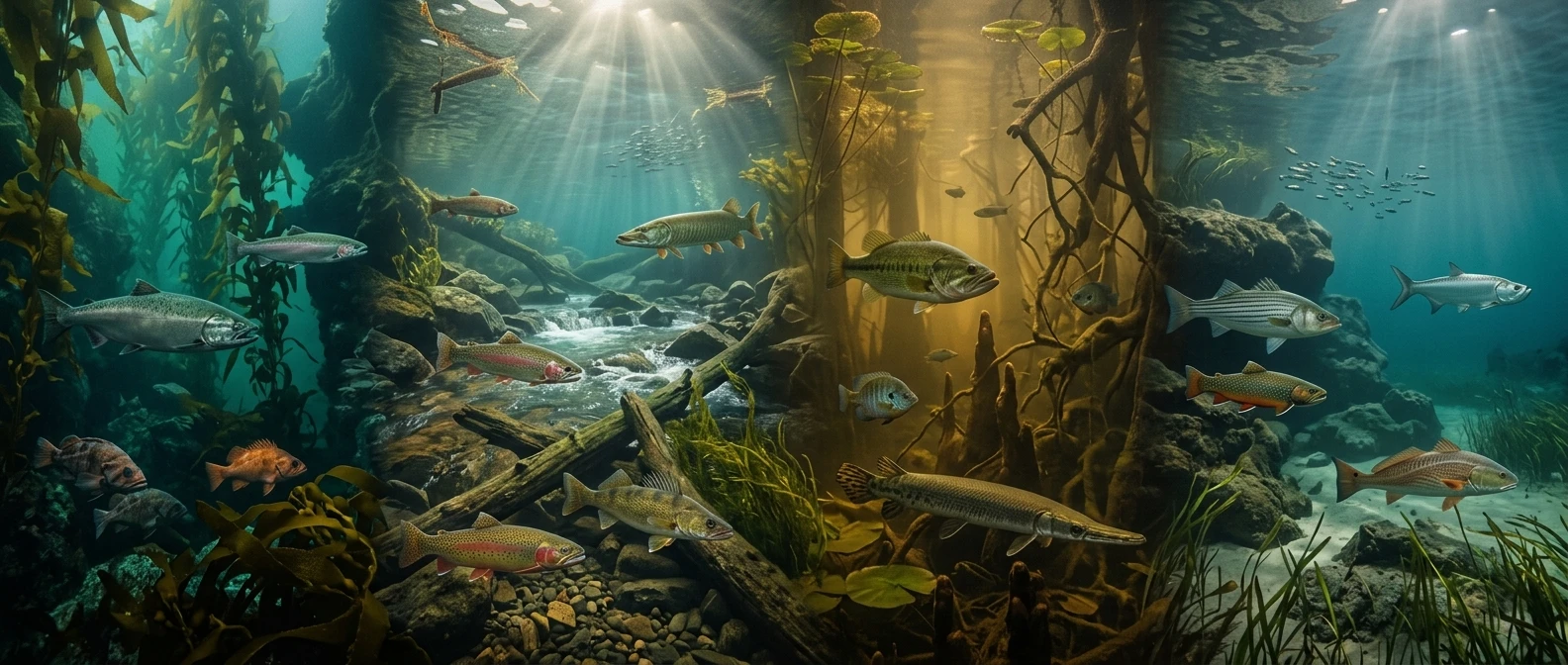
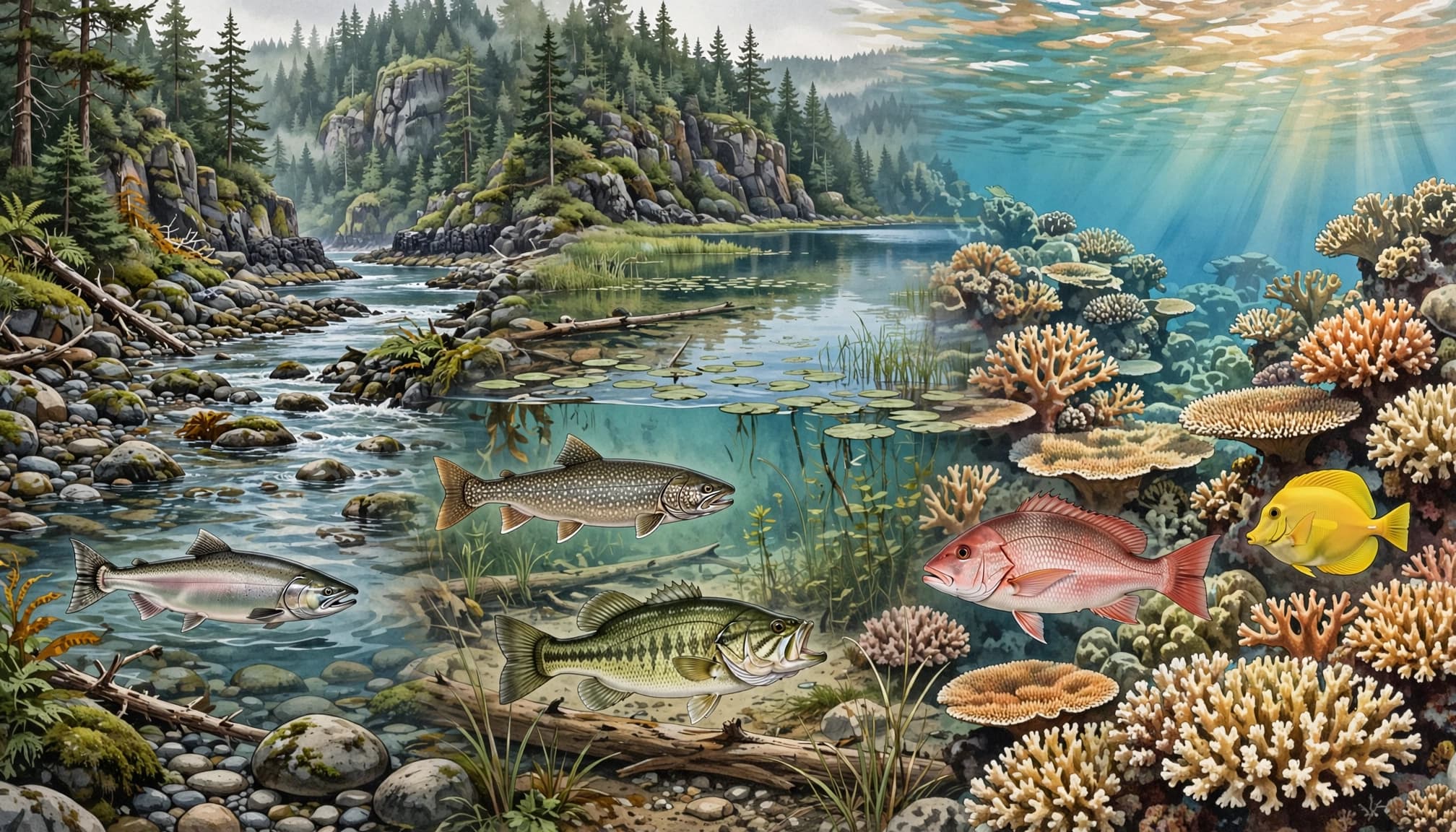
Fish species across America vary with the water they live in, from Arctic grayling and salmon in Alaska’s cold rivers to bass and bluegill in inland lakes, flounder in coastal bays, red drum in Gulf estuaries, and reef fish in Hawaiʻi. The habitat shapes which fish you’ll find and what kind of fishing gear makes sense.
I’ll use regional examples to show how much that variety changes across the country. Before planning a trip, check local range records for your target fish, then choose a fishing combo for your target species.
Quick regional snapshot
Alaska and the Pacific Coast
Examples include Pacific salmon in rivers and coastal waters, plus marine fish such as halibut, pollock, and rockfish.
Great Lakes and Mississippi Basin
Lakes and rivers support fish such as walleye, yellow perch, lake trout, bass, catfish, and paddlefish.
Northeast, Southeast, and Gulf
Examples range from cod and haddock in northern waters to red drum, spotted seatrout, snappers, and groupers farther south.
Hawaiʻi and U.S. Pacific Islands
Nearshore reefs support reef fish, while offshore waters are habitat for open-water fish such as tuna.
These are representative examples, not a complete list. Local ranges vary by waterbody and habitat.
Key Takeaways
- Fish species vary by region and habitat. Alaska’s cold rivers hold salmon and trout, the Great Lakes support walleye, and many southern lakes and rivers have bass, catfish, and bluegill.
- Coastal fish communities vary by shoreline, water conditions, and habitat. Red drum are common in parts of the Southeast and Gulf.
- I check the USGS freshwater fish native-range data to distinguish a fish’s natural range from an introduced occurrence.
- Match your rod and reel to the fish and method you plan to use. Understanding rod power and action helps narrow down a setup that fits.
Fish Species in the United States: What Lives in Each Region
The fish you find across the United States depend on whether you’re fishing a river, lake, freshwater stream, coast, or offshore reef. I treat regional species lists as a snapshot, not a promise: ranges overlap, and no single list fits every waterbody.
Alaska and the Pacific Coast
Pacific salmon include sockeye, Chinook, coho, chum, and pink salmon. They hatch in freshwater, move through rivers and estuaries toward the ocean, then return to freshwater to spawn. Salmon timing and life-cycle details vary by species and population. NOAA’s Pacific salmon life-cycle overview explains those different stages.
Saltwater fish vary with location, depth, and season. Pacific halibut, pollock, sablefish, rockfish, and sardine are examples, but you won’t find the same mix along every stretch of coast. Salmon also spend much of their lives at sea, so the fishery changes as they move between ocean and river.
The Great Lakes and Mississippi River Basin
These lakes and rivers hold a wide range of fish. Great Lakes examples include lake trout, walleye, yellow perch, northern pike, largemouth bass, smallmouth bass, and bluegill. The Great Lakes Fishery Commission’s overview describes several predator and prey species in the basin.
Farther south and west, the Mississippi River system supports channel catfish and paddlefish, alongside bass and bluegill in many waters. Common carp, sea lamprey, and Asian carps are nonnative examples, but their presence differs by lake, river, and connected watershed. Check local records before assuming a species lives in a particular spot.
The Northeast, Southeast, Gulf, and Caribbean
In the Northeast and Mid-Atlantic, marine and coastal examples include Atlantic cod, haddock, striped bass, and Atlantic salmon. Cod and haddock are associated with northern marine waters, while striped bass use coastal waters and estuaries. Atlantic salmon remain in some rivers, where local populations vary. Brook trout live in suitable cold streams in parts of the Northeast. Atlantic menhaden are another important coastal fish and a major food source for striped bass and other predators.
Farther south, habitats shift among estuaries, coastal waters, reefs, and the Gulf. Red drum and spotted seatrout are common examples in southeastern and Gulf waters; snappers and groupers are associated with warmer coastal and reef habitats, including the U.S. Caribbean. For current regional profiles, NOAA lists Atlantic striped bass and Atlantic menhaden. Check state or NOAA records for local ranges.
Hawaiʻi and the U.S. Pacific Islands
Island reefs support fish that feed, shelter, and reproduce among coral and rocky structure. Some endemic species are naturally restricted to a particular island or area. Offshore waters are a different habitat, used by open-water fish such as tuna. NOAA tracks Pacific bigeye tuna in the region, and its species profile is a useful starting point.
Reef fish and tuna aren’t interchangeable examples of island fishing. One group is tied to nearshore habitat; the other ranges through open water. Check local species listings for the island and habitat you plan to fish.
How Habitats and Life Cycles Shape Fish Distribution
A fish’s range depends on more than its region. Water temperature, salinity, depth, food, and spawning needs all affect where it can live. Many fish also move between habitats as they grow, so a species may use rivers, estuaries, coastal waters, and the open ocean during different parts of its life.
From Headwater Streams to Reefs and Deep Water
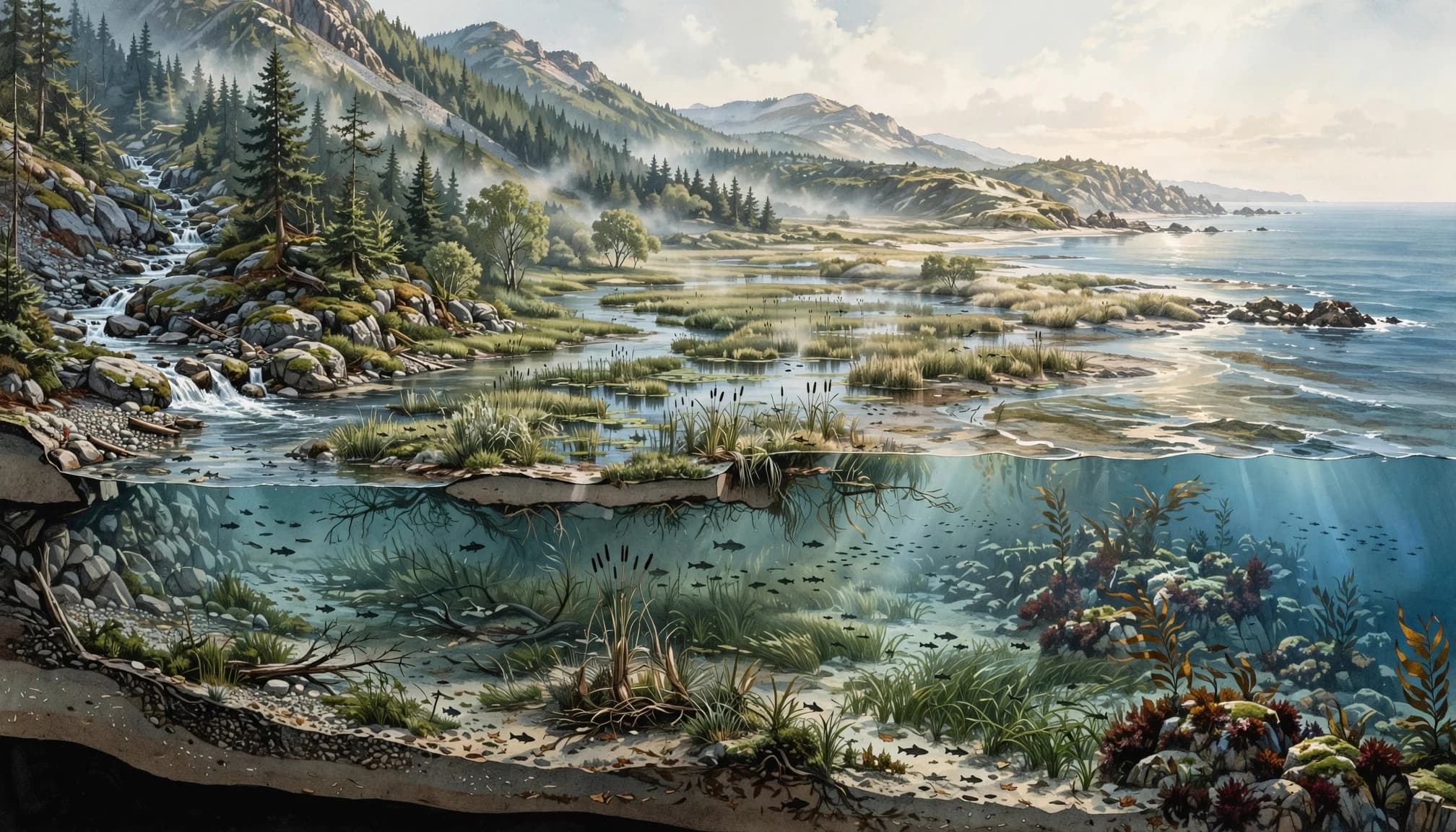
Cold, clear headwater streams suit fish that need cool water and steady oxygen. Farther downstream, large rivers offer deeper channels, faster currents, and varied food and cover. Lakes and reservoirs add open water, shorelines, and submerged structure, while wetlands provide shallow, plant-filled areas that shelter young fish.
Saltwater habitats vary just as much. Estuaries are places where fresh water and salt water mix. Seagrass beds, coral reefs, kelp forests, and rocky reefs provide food and shelter in coastal waters; deeper ocean areas support fish adapted to open water and different depths.
Spawning needs can narrow a fish’s range further. Some freshwater fish need gravel beds and flowing water for eggs, while others spawn among plants or on the seafloor. Salmon, for example, grow at sea but return to freshwater to spawn. NOAA describes these movements in its overview of fish life cycles and estuaries. A fish may be present in one habitat as an adult and depend on another for its young.
How many Pacific salmon use rivers and the ocean
- Hatch: Young salmon begin life in freshwater.
- Move: Many migrate through rivers and estuaries toward the ocean.
- Grow: They spend part of their lives feeding at sea.
- Return: They return to freshwater to spawn.
The timing and details differ among salmon species and populations.
Native, Introduced, and Invasive Fish
A native fish occurs naturally in an area. An introduced fish has been moved beyond its natural range, often by people. Introduced fish are called invasive when they spread and cause harm. The terms aren’t interchangeable: a fish can be introduced without having a known harmful effect in every waterbody.
Common carp are introduced and widespread across the United States. Their feeding can disturb bottom sediments and damage aquatic vegetation, though the effects vary by location. Sea lamprey are another introduced example, with serious impacts on Great Lakes fish. “Asian carps” refers to several species, including bighead, silver, grass, and black carp; some compete with native fish for food or habitat.
I treat these examples as a reason to check local records, not as proof that every introduced fish causes the same problem everywhere. A species’ impact depends on its abundance, the habitat, and which native fish live there.
What Threatens Fish and How to Check Local Species
Fish face different pressures depending on their habitat. A dam may block spawning access in one river, while pollution or heavy fishing pressure matters more in another. I check local records before treating a species as common, declining, or present in a particular waterbody.
Threats vary by habitat and region
Habitat loss can remove spawning areas, shelter, and food. Development may reduce wetlands or damage streambanks, while pollution can degrade water quality. Dams, culverts, and other barriers can stop fish from reaching upstream habitat. Changes to water flow and temperature can also affect where fish feed, spawn, or survive. These pressures don’t affect every region or species in the same way.
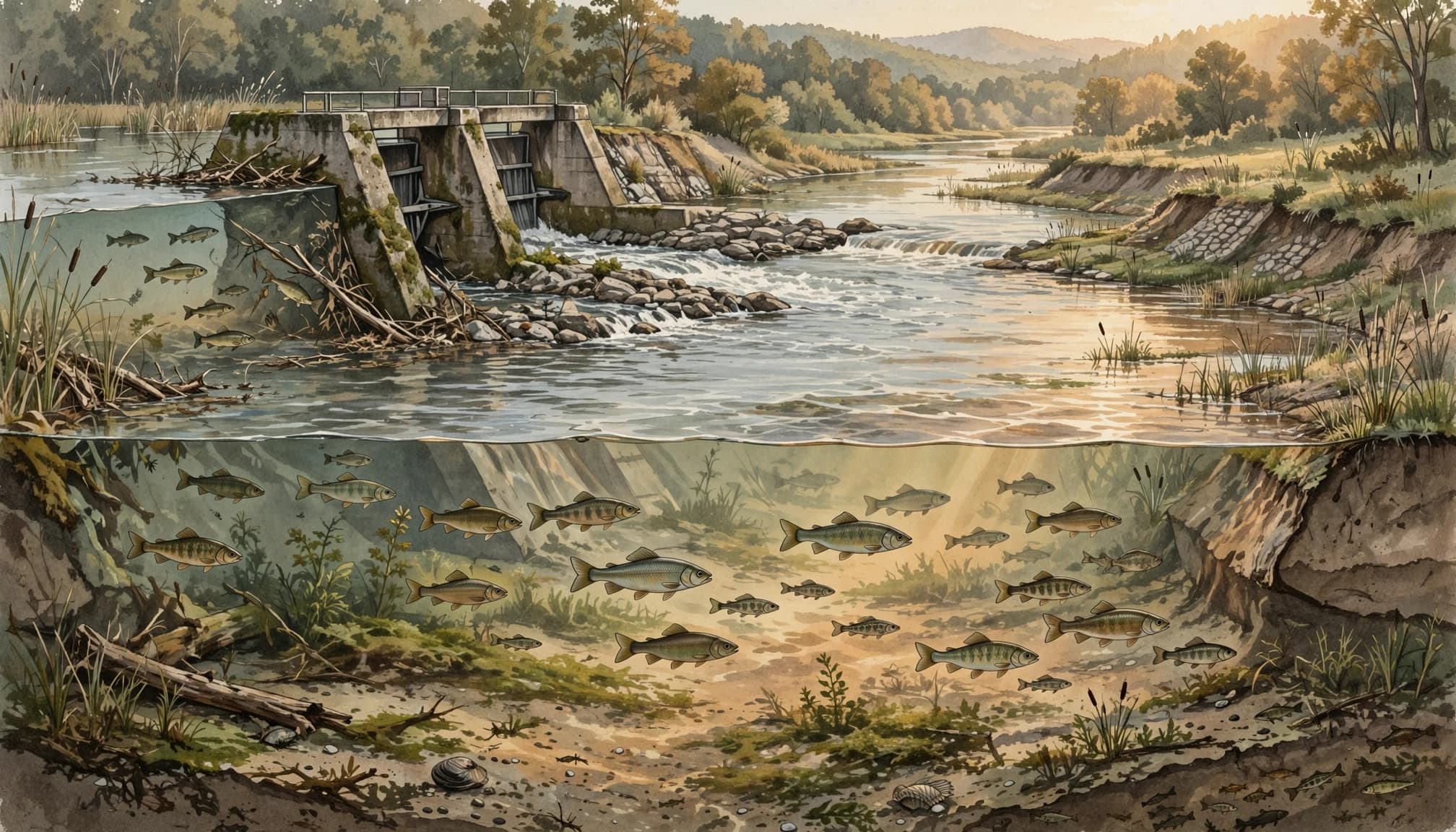
Fishing pressure can influence some populations, especially when harvest rules don’t account for local conditions. Invasive fish may compete with native species or alter habitat, but their effects depend on the species and the waterbody. A record of an introduced fish alone doesn’t prove it is established or causing harm there.
For a broader view of habitat pressures, NOAA’s habitat conservation resources cover research and data used to support fisheries and habitat management.
Check current local records and rules
I use several sources because each answers a different question. USGS freshwater occurrence records can show where a fish has been reported, but a record doesn’t confirm that it’s still present or abundant today. Check its date and location, then compare it with the fish’s native range and local agency information.
Before you fish, check these details
- Identify the exact fish species you plan to target.
- Check records for the specific lake, river, or coastal area.
- Compare the record date and location with current local agency information.
- Check fishing seasons, size limits, bag limits, and closures separately.
A species record does not confirm that fish are abundant now or that fishing is allowed at that location.
For conservation status, search the U.S. Fish and Wildlife Service’s species resources for profiles and federal listing details. A federal status doesn’t tell you everything about a local population, so check state fish and wildlife agency pages for current range information and waterbody-specific updates.
If you’re looking at coastal or marine fish, NOAA’s regional resources can help you find species information and applicable fishery rules. Before fishing, confirm regulations with the state or territorial agency, or the appropriate federal authority for the area. Seasons, size limits, bag limits, and closures can change, and the rules may differ between nearby waters.
I treat mapped ranges as a starting point, not a guarantee. Occurrence records, conservation status, and fishing regulations describe different things, so check each one for the location and species you have in mind.
Frequently Asked Questions
Fish range maps and species lists are useful starting points, but they don’t answer every question about a specific lake, river, or stretch of coast. I use them alongside local agency information, especially when a fish’s range or life cycle affects where you might find it.
How many fish species live in the United States?
There isn’t one reliable total without first defining what counts. A list limited to fish in rivers and lakes will differ from one that includes marine species, U.S. island waters, introduced fish, and newly recognized species. Classification also changes as researchers revise species groups, so I avoid relying on a single number without a clear scope and source.
Which fish are found in nearly every region?
No single fish lives in every U.S. region, and familiar names can hide important range differences. Bass and catfish are broad groups, not individual species with one coast-to-coast range. Check the state or watershed record for the exact species and waterbody; a fish common in one region may be absent or introduced in another.
Are all nonnative fish invasive?
No. Nonnative describes where a fish originated, while invasive describes a nonnative species that spreads and causes harm to ecosystems, economies, or human health. I use the USGS Nonindigenous Aquatic Species database to look for reported introduced species, then check local sources for their status and effects in that waterbody.
Where can you check which fish live nearby?
For freshwater ranges, start with your state fish and wildlife agency, then check a basin or interstate fisheries agency when the watershed crosses state lines. A state fish is a state symbol, not proof that the species occurs in every waterbody in that state. USGS records can help with reported nonnative aquatic species, while NOAA’s species directory covers many marine fish and regional fisheries. Check the date and location on each record; a report from one place or year doesn’t confirm current presence somewhere else.
Why do some fish move between rivers and the ocean?
Salmon are a clear example: they hatch and begin life in rivers, grow in the ocean, then return to rivers to spawn. This pattern is called anadromy, but the timing and length of each stage vary among species and populations. Other fish have different movement patterns, so a coastal record doesn’t always mean a species stays in saltwater year-round.
How should I choose gear for a fish species?
Start with the fish you expect to catch most often, then match rod power and reel size to its size, your lures, and the water you fish. Light gear helps with panfish and trout, while bass in heavy cover or larger catfish may call for more backbone and line capacity. A well-matched, affordable combo usually makes more sense than buying heavier gear for fish you rarely target.
A simple starting point for matching gear
Panfish and smaller trout
Light tackle can suit smaller fish and lures, depending on the water and fishing method.
Bass near heavy cover
More rod power and suitable line may help when fishing around weeds, wood, or other cover.
Larger catfish
Consider the fish size, current, bait, and line capacity when choosing a rod and reel.
Treat these as starting points. Match your setup to local conditions, fishing method, and regulations.
Final Cast
America’s fish diversity reflects its varied regions and connected habitats. A species list or range map is a starting point, so I check local records for the specific waterbody before treating a fish as present.
Rivers, wetlands, lakes, estuaries, and reefs all support fish at different stages of life. Protecting those waterways helps preserve the habitats fish depend on.