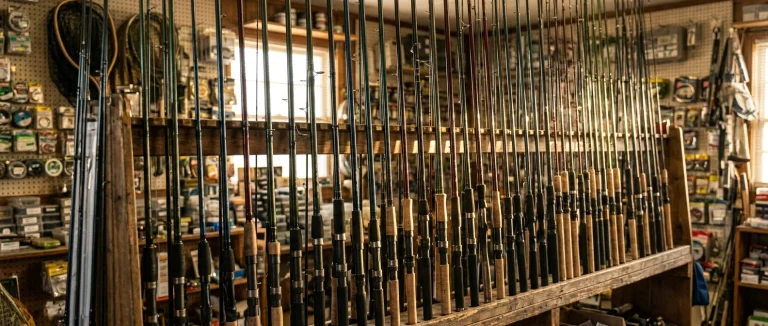

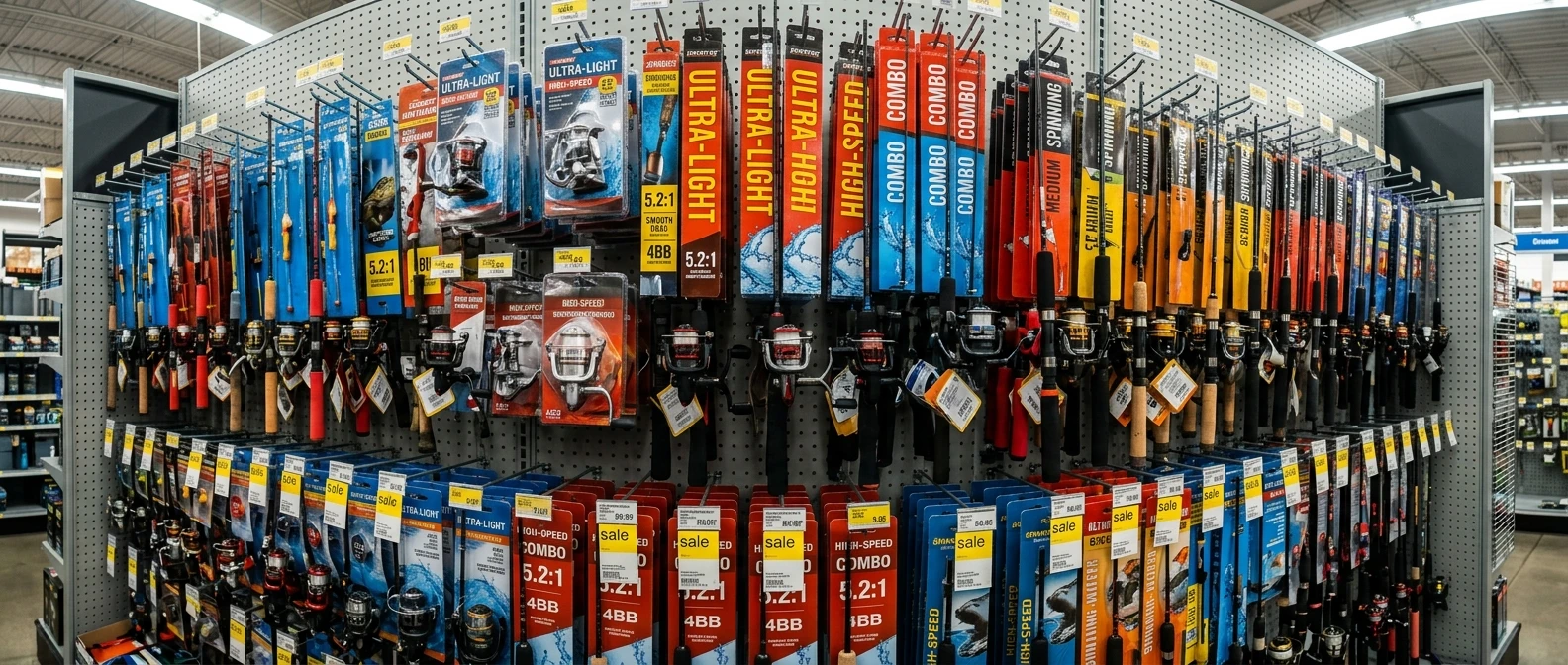
If you’re hunting for the best beginner spinning combo, you have probably already stood at the big box store in front of a wall of combos, and every package looks like it was designed to confuse you. Bright colors, big numbers, words like “ultra-light” and “high-speed” printed everywhere, and a price tag that may or may not tell you anything useful. The truth is that picking the right spinning combo isn’t about finding the best-reviewed one or the shiniest reel. It’s about matching the gear to the fish you’re actually going after. Get that match right and your first few trips go a lot smoother. Get it wrong and you’ll spend more time fighting your own equipment than fighting fish.
This guide walks through that matching process so you can buy once and buy right.
Quick answer: What should a beginner spinning combo be?
For many freshwater beginners, a versatile starting setup is a medium-power, fast-action spinning rod paired with a 2500 to 3000 size reel.
- Rod Medium power, fast action
- Reel 2500 to 3000 size
- Gear ratio About 5.2:1 to 6.0:1
- Line 6 to 10 lb monofilament
Match it to your target fish. Panfish, larger bass, catfish, and inshore fish may call for different rod power, reel size, and line.
Figure Out What You’re Actually Going to Fish For
Before you look at a single rod or reel, answer one question: what fish do you want to catch most often?
Focus on what you’ll fish for on a typical Saturday, not what you hope to catch someday. If you’ll mostly target panfish and small bass in a pond or local lake, you’ll need one type of setup. Largemouth bass in weedy lakes call for a different combo. Catfish in a river need their own gear, and coastal anglers targeting redfish or stripers need equipment suited to those fish.
A lot of beginners try to buy one combo that does everything. You can get close to an all-purpose setup, and we’ll cover that, but “does everything” usually means “does nothing particularly well.” A rod built for finesse panfish fishing will get overpowered fast by a decent largemouth, and a rod built for bass will feel like a broomstick when you’re trying to feel a bluegill nibble a worm.
So start here. Write down your target species, or at least your top two. Everything else in this article builds off that answer.
Choose the fish before you choose the combo
Start with the fish you expect to catch most often. Use these as starting points, not rules for every fishing situation.
Panfish and trout
Starting point: Light power with fast or moderate-fast action.
Priority: Casting light lures and feeling smaller bites.
Largemouth bass
Starting point: Medium or medium-heavy power with fast action.
Priority: Matching your lures and having enough backbone for the cover you fish.
Catfish or inshore fish
Starting point: Medium-heavy to heavy power, depending on fish size and conditions.
Priority: Enough line capacity, drag, and strength. For saltwater, choose suitable equipment.
Still undecided? Medium power with fast action is a versatile starting point for many freshwater beginners.
Rod Power and Action: What They Really Control
Rod specs confuse people because the terms sound similar but control different things.
Power describes how much force it takes to bend the rod. A light power rod bends with light pressure. A medium-heavy or heavy power rod needs a lot more pressure to bend the same amount. Power is about how much lure weight and line strength the rod is designed to handle, and how much backbone it has to fight a fish.
Action describes where along the blank the rod bends, and how quickly it returns to straight. A fast action rod bends mostly in the top third and snaps back quickly. A moderate action rod bends further down the blank and loads more slowly. Action affects how well you feel a bite, how well you set the hook, and how forgiving the rod is when a fish makes a sudden run.
Rod power and action are separate characteristics. For example, a rod can have medium power and fast action, or medium-heavy power and moderate action. They’re measured independently, not along the same scale.
For most beginners targeting panfish, trout, and smaller bass, a light to medium power rod with fast or moderate-fast action gives you enough sensitivity to feel light bites without being so soft that you can’t control a fish. As for largemouth bass, a medium or medium-heavy power rod with fast action handles most lures and gives you the backbone to set hooks through vegetation. If looking at bigger water, species like catfish or redfish call for medium-heavy to heavy power, since you need more lifting force and more resistance to line stress.
If you’re not sure, medium power with fast action is the most versatile combination for freshwater beginners. It handles a wide range of lure weights and line strengths without being specialized in a way that limits you.
Power and action answer different questions
Power: How much force bends it?
Light power bends under less pressure. Heavier power takes more pressure to bend.
Use it to help match: Lure weight, line strength, and the demands of your fishing.
Action: Where does it bend?
Fast action bends mainly near the tip. Moderate action bends farther down the rod.
Use it to help match: Your presentation, hook-setting needs, and how much forgiveness you want.
Read both ratings: A rod can be medium power and fast action. Those descriptions do not conflict.
Before buying: Check the manufacturer’s recommended line and lure weights, usually printed near the handle.
Resource: Kentucky Fish and Wildlife’s guide to rod power and action.
Matching Reel Size and Gear Ratio to the Rod
Reel size is labeled by number, usually something like 1000, 2500, 3000, or 4000. Those numbers represent spool capacity and overall reel size, and they’re meant to pair with specific rod powers.
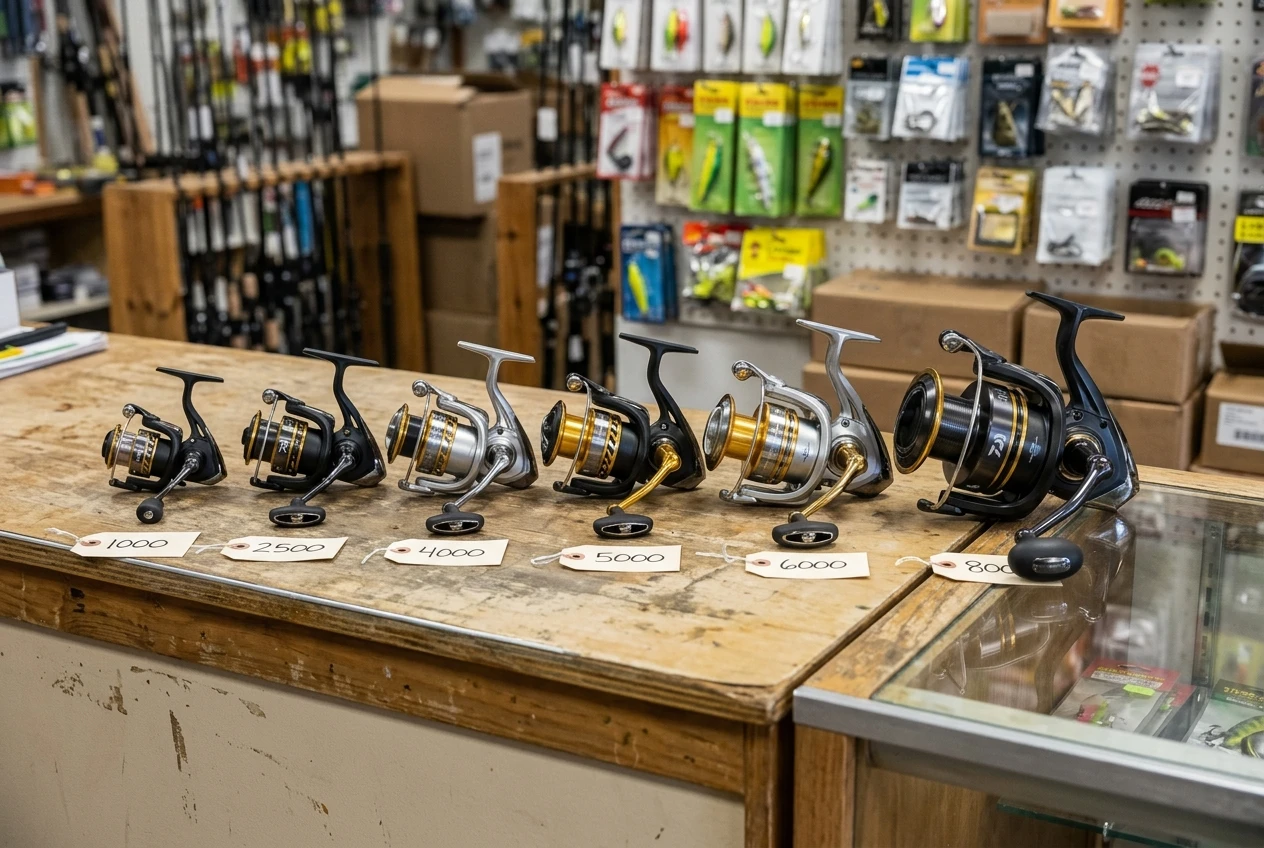
- A 1000 to 2500 size reel pairs well with light power rods for panfish and trout.
- A 2500 to 3000 size reel is the sweet spot for medium power bass rods.
- A 3000 to 4000 size reel pairs with medium-heavy to heavy rods for bigger bass, catfish, or light saltwater work.
Mismatching reel size and rod power throws off the balance of the whole combo. A big, heavy reel on a light rod makes the setup tip-heavy and tiring to hold all day. A tiny reel on a heavy rod won’t hold enough line and won’t have the drag strength to handle a strong fish.
Gear ratio is the other number to pay attention to, usually written like 5.2:1 or 6.2:1. That number tells you how many times the rotor turns around the spool for each full turn of the handle. A lower ratio, something in the 5.0:1 to 5.4:1 range, turns slower but gives you more cranking power. A higher ratio, up in the 6.0:1 to 7.0:1 range, retrieves line faster and is handy for techniques where you need to cover water quickly or take up slack fast.
For a first combo, a reel in the 5.2:1 to 6.0:1 range is a solid middle ground. It’s fast enough to not feel sluggish and still gives you enough torque to fight fish without the handle feeling like it’s fighting back.
A quick guide to reel numbers
These are the broad starting ranges used in this guide. Check the specific reel’s weight, line capacity, and drag before buying.
1000 to 2500
A starting range for light-power setups used for panfish and trout.
2500 to 3000
A starting range for medium-power bass and general freshwater setups.
3000 to 4000
A starting range for some medium-heavy setups and light inshore fishing. Larger fish or demanding conditions may need more capacity.
What does 5.2:1 mean? The rotor makes 5.2 revolutions around the spool for each full turn of the handle.
Beginner starting range: The article suggests 5.2:1 to 6.0:1 for a middle-ground retrieve speed.
Do not compare size labels alone: Reel-size numbers are not standardized across brands. Compare the actual model specifications.
Resource: West Marine’s spinning reel selection guide.
Line Choice for a First Setup: Mono, Fluoro, or Braid
Line matters as much as the rod and reel, and it’s where a lot of combos ship with something that’s fine for a demo cast but not great for actual fishing.
Monofilament stretches, floats, and is the most forgiving line for beginners. That stretch helps absorb sudden hook sets and hard runs, which means fewer break-offs while you’re still learning how much pressure you can put on a fish. It’s also the cheapest and easiest to tie knots with. For a first spool, monofilament in the 6 to 10 pound test range covers most freshwater panfish and bass situations.
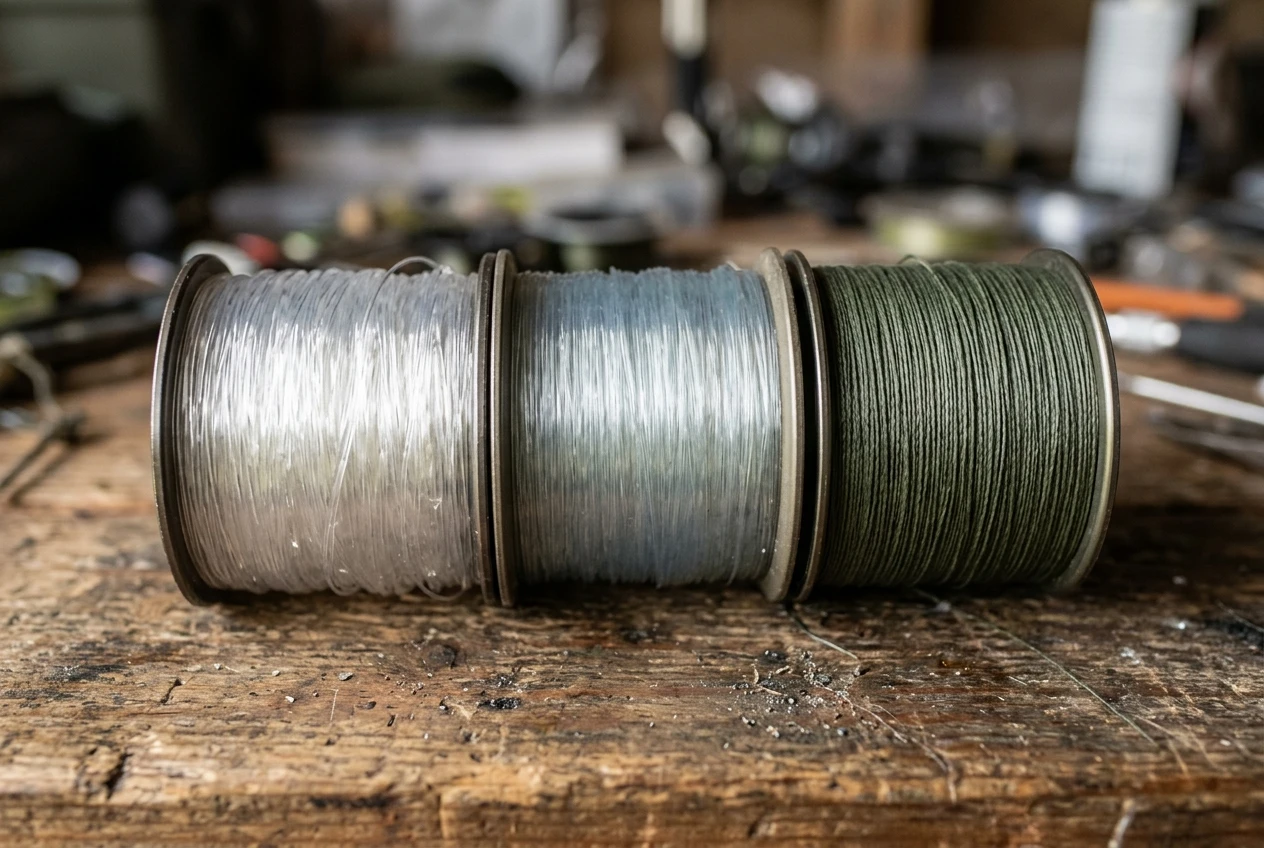
Fluorocarbon sinks, has less stretch, and is nearly invisible underwater. It’s a good leader material or a good main line for clear water finesse fishing, but it’s stiffer and more prone to coiling on a reel spool than mono, which can be an extra headache while you’re still learning to cast.
Braid has almost no stretch, is thinner than mono or fluoro at the same strength, and lets you feel everything happening at the end of your line. That sensitivity is great once you know what you’re feeling. For a brand new angler, braid can actually work against you, because it transmits every bump so directly that light bites and snags can feel identical, and the lack of stretch means a hard hookset on light line can pop it or pull hooks free.
For a first setup, plain monofilament is the easiest line to learn on. Once you’ve got some trips under your belt and you understand how a fish feels on the line, braid with a fluorocarbon leader becomes a worthwhile upgrade for techniques where sensitivity and bite detection matter more.
Keep your first spool simple
Mono is affordable, forgiving, and easy to tie knots with. Its stretch helps absorb sudden pressure while you learn.
Starting range: The article recommends 6 to 10 lb test for many freshwater panfish and bass situations. Match the line to your rod’s rating, target fish, and fishing conditions.
When to consider fluorocarbon
Consider it for leaders or clear-water presentations. As a main line, its stiffness and tendency to coil can add frustration for a beginner.
When to consider braid
Consider it when greater sensitivity matters and you are comfortable managing line tension and hook sets. Its low stretch makes it less forgiving of sudden pressure.
Combo Options by Budget and Target Species
You don’t need to spend a lot of money to get a combo that performs well for a beginner. What matters more than the dollar amount is whether the power, reel size, and line match your target species.
Entry-level combos in the lower price tier are perfectly capable for panfish, trout, and smaller bass. They won’t have the smoothest drag system or the lightest components, but for someone learning to cast, set hooks, and land fish, they do the job. Look for a medium-light to medium power rod paired with a 2000 to 2500 size reel.
Mid-range combos add smoother drag systems, better quality guides, and reels with more ball bearings, which translates to a smoother retrieve and better feel. This tier is where most dedicated bass or all-purpose freshwater anglers land. A medium power, fast action rod with a 2500 to 3000 reel in this range will handle a wide variety of lures and situations well.
Upper-tier combos aren’t always necessary for a first setup, but if you already know you’re going after bigger fish, like catfish in a river or inshore saltwater species, spending more for a heavier power rod and a reel with a sealed drag and stronger gearing starts to make real sense. Saltwater and catfish applications put more strain and more corrosive stress on gear than panfish and bass do, so this is a case where the extra cost buys real durability rather than just polish.
The honest takeaway here is that a well-matched inexpensive combo will outperform a mismatched expensive one every time. Spend your money matching the gear to the fish before you spend it chasing brand names.
Mismatches That Ruin a New Angler’s First Few Trips
Most frustrating first trips trace back to one of these mismatches, not bad luck or bad fishing.
- Rod too heavy for the target species. A medium-heavy bass rod makes it nearly impossible to feel a panfish bite or cast a light lure accurately.
- Rod too light for the target species. Trying to horse a decent-sized catfish or bass on an ultralight rod ends in a snapped line, a bent hook, or a rod that just can’t apply enough pressure.
- Reel too big or too small for the rod. This throws off the balance of the whole setup and makes it awkward to hold and cast for long periods.
- Line too heavy for the lure weight. Heavy line resists casting and makes light lures sail off target or not cast far at all.
- Line too light for the target fish’s power. This leads to break-offs right when you finally hook something worth landing, which is about as discouraging as it gets for a new angler.
- Drag set too tight. A drag cranked all the way down doesn’t give at all when a fish runs, which puts the full load on your line and hooks and often ends with a snapped line on the first real fight.
If your first few trips felt harder than they should have, it’s worth checking your setup against this list before assuming the fishing itself was the problem.
Check the setup before blaming the fishing
A few gear checks can save a frustrating first trip.
- Rod power matches the job Avoid a rod too stiff for small bites or too light for the fish and cover you expect.
- Reel suits the rod Check the combo’s balance, line capacity, and drag capability.
- Line suits the lure and fish Avoid heavy line that makes light lures difficult to cast, or line too light for your conditions.
- Drag can release line Do not simply crank it all the way down. The drag needs to give when a fish puts enough pressure on the line.
A matched setup matters more than a shiny reel or a big price tag.
When to Upgrade One Piece Instead of Buying a Whole New Combo
Once you’ve fished a combo for a season or two, you’ll start to notice specific limitations rather than a general sense that something feels off. That’s useful information, because it usually points to one piece of gear, not the whole setup.
If you’re missing light bites, the issue is often the rod’s sensitivity or action, and a rod upgrade alone can fix it. When your reel feels gritty, hesitates under load, or the drag grabs instead of releasing smoothly, that’s a reel problem, and a better reel on your current rod can solve it without replacing anything else. Is you’re breaking off fish or your line keeps twisting and coiling? That’s almost always a line problem, and re-spooling with a different line type is the cheapest fix available to you.
Fix the weak link, not the whole combo
Use the problem you notice to decide what to check first.
Missing light bites?
Review the rod’s sensitivity, power, and action before replacing a reel that still works well.
Gritty retrieve or grabbing drag?
The reel may be the weak link. A reel upgrade can make sense if your rod still suits your fishing.
Coiling or repeated break-offs?
Inspect your line choice and condition first. Re-spooling can be a much cheaper fix than buying another combo.
When a new combo makes sense: Your target species or fishing conditions have changed enough that the rod, reel, and line all need to change together.
Replacing a whole combo makes sense when your target species has changed, like moving from panfish to bass or from freshwater to light saltwater work, since that usually means the rod power, reel size, and line all need to shift together. But if you’re happy with your species and just want better performance, upgrading one piece at a time is the smarter way to spend your money.
Check out our full breakdown of spinning combos by budget so you can match the exact setup to your target species before you buy. (ARTICLES COMING SOON)
Beginner Spinning Combo FAQs
What spinning combo is a good all-purpose choice for a beginner?
For many freshwater beginners, a medium-power, fast-action rod paired with a 2500 to 3000 size reel is a versatile starting point. The guide suggests 6 to 10 lb monofilament and a gear ratio around 5.2:1 to 6.0:1. Adjust the setup for your target fish and check the rod’s recommended line and lure ratings.
What is the difference between rod power and rod action?
Power describes how much force it takes to bend a rod. Action describes where along the rod it bends. They are separate ratings, so a rod can be medium power and fast action.
What reel size should I get for a beginner spinning rod?
As a starting point, the guide pairs 1000 to 2500 size reels with light-power rods, 2500 to 3000 size reels with medium-power rods, and 3000 to 4000 size reels with medium-heavy to heavy rods. Reel-size labels can vary by brand, so check the specific reel’s weight and line capacity.
What fishing line is easiest for a beginner to use?
Monofilament is a forgiving first choice. It stretches, is easy to tie, and is usually less expensive than other line types. The guide suggests 6 to 10 lb test for many freshwater panfish and bass situations, but match your line to your rod, target fish, and conditions.
Do beginners need to buy an expensive spinning combo?
No. A well-matched, lower-cost combo can be a better choice than an expensive setup that does not suit your target fish. Focus first on matching the rod, reel, and line to how you plan to fish.
Should I replace my whole combo if one part is not working well?
Not always. If the rod still suits your fishing, you may only need to change the reel or line. Replacing the whole combo makes more sense when your target fish or fishing conditions call for a different setup.